
Artificial intelligence has moved from experimental curiosity to boardroom priority almost overnight. Yet for every organization that successfully embeds AI into its daily operations, several more find their pilots stuck in “proof of concept” purgatory: technically impressive, but never actually used. The reason usually has very little to do with the technology itself.
The Real Barriers To AI Adoption
Process-first thinking creates resistance, not results. Many organizations approach AI the way they approach any other software rollout: define the ideal process, select a tool that automates it, and then train employees to comply. This works reasonably well for deterministic systems like an ERP module. It works poorly for AI, because AI changes how people think and decide, not just what buttons they click. When the process is designed first and people are expected to conform to it, the tool feels imposed rather than useful and adoption stalls.
Trust is earned, not mandated. Employees are naturally skeptical of a system that makes recommendations or automates judgment calls they used to own. If they don’t understand why the AI reached a conclusion, or if it doesn’t match the tacit knowledge they’ve built over years, they’ll quietly work around it. No amount of policy enforcement fixes a trust gap.
Fear of obsolescence. Many employees interpret “we’re adopting AI” as “we’re being replaced.” Left unaddressed, that anxiety produces quiet sabotage: incomplete data entry, workaround processes, or simply ignoring the new tool.
Data and workflow fragmentation. AI is only as good as the data and processes feeding it. Organizations that haven’t standardized their underlying business processes often find that AI initiatives expose, rather than fix, years of inconsistent data handling.
Unclear ownership. AI projects frequently fall into a gap between IT (which owns the technology) and the business units (which own the outcomes). Without a clear owner who understands both the technical capability and the human workflow it touches, projects drift.
OAN’s Approach: People First, Then Process
At OAN, we start from a different premise: AI adoption is a change management challenge before it’s a technology challenge. That reshapes how we run every engagement.
- We talk to the people doing the work before we design anything. That includes the AP clerks, the customer service reps, and the project managers, because we want to understand what actually happens rather than what the org chart says happens.
- We design the process around how people actually think and work instead of the reverse. Automation is shaped to fit real decision points and real exceptions before anything gets formalized.
- We build in transparency instead of black boxes. Whenever AI makes a recommendation, the reasoning behind it is visible, so employees can validate it, override it, or learn from it.
- We treat adoption as a milestone rather than an afterthought. Success means the system is still trusted and used weeks and months later, not just that it was deployed on schedule.
- We keep humans in the loop where it matters. AI removes drudgery and surfaces better information, but it does not remove accountability.
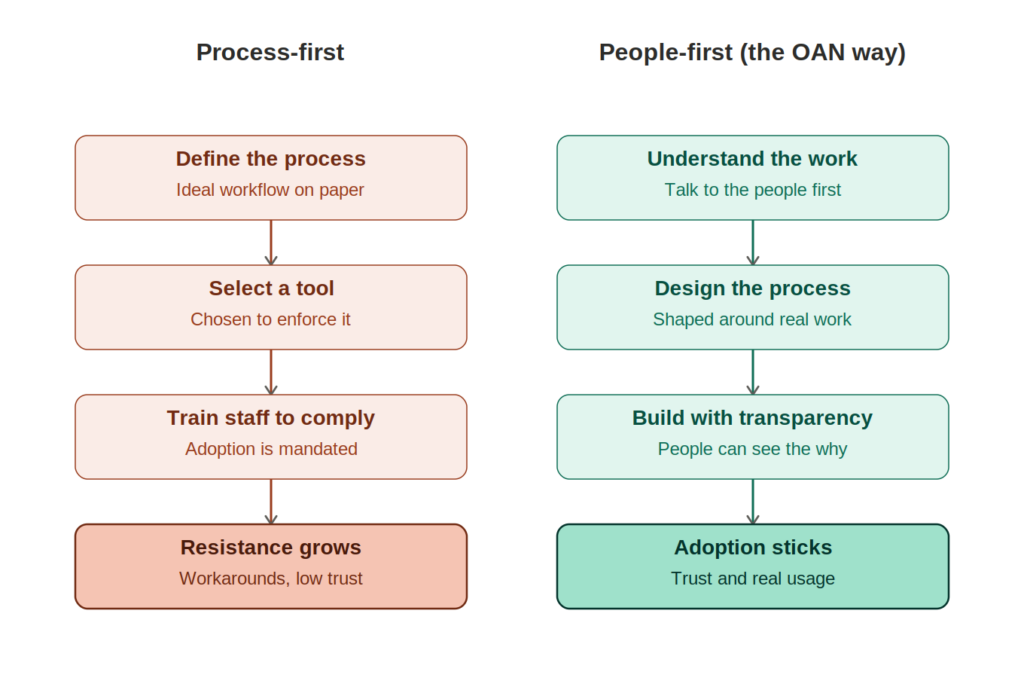
Process-first implementations move toward compliance and resistance. People-first implementations move toward trust and lasting adoption.
Why This Matters
Organizations that lead with process end up with technically functional systems nobody wants to use. Organizations that lead with people end up with systems that get embraced, refined, and expanded because the people using them helped shape them from the start.
AI adoption isn’t won in the software configuration. It’s won in the conversations that happen before a single line of automation is built.
Interested in how oAppsNET can support AI implementations at your organization? Reach out to start with a conversation, not a checklist. Visit https://www.oappsnet.com/contact/ or stop by our booth at AI World in Las Vegas.