
Blog & insights Vendor Management
Letting Suppliers Check Payment Status Themselves: The Case for Self-Service
"Where is my payment?" may be the most common question in accounts payable. Suppliers ask it by email, by phone, and through their account managers. Each question is reasonable, because suppliers have their own cash flow to manage. But when the same handful of questions…
Vendor Management·October 29, 2026·4 min read
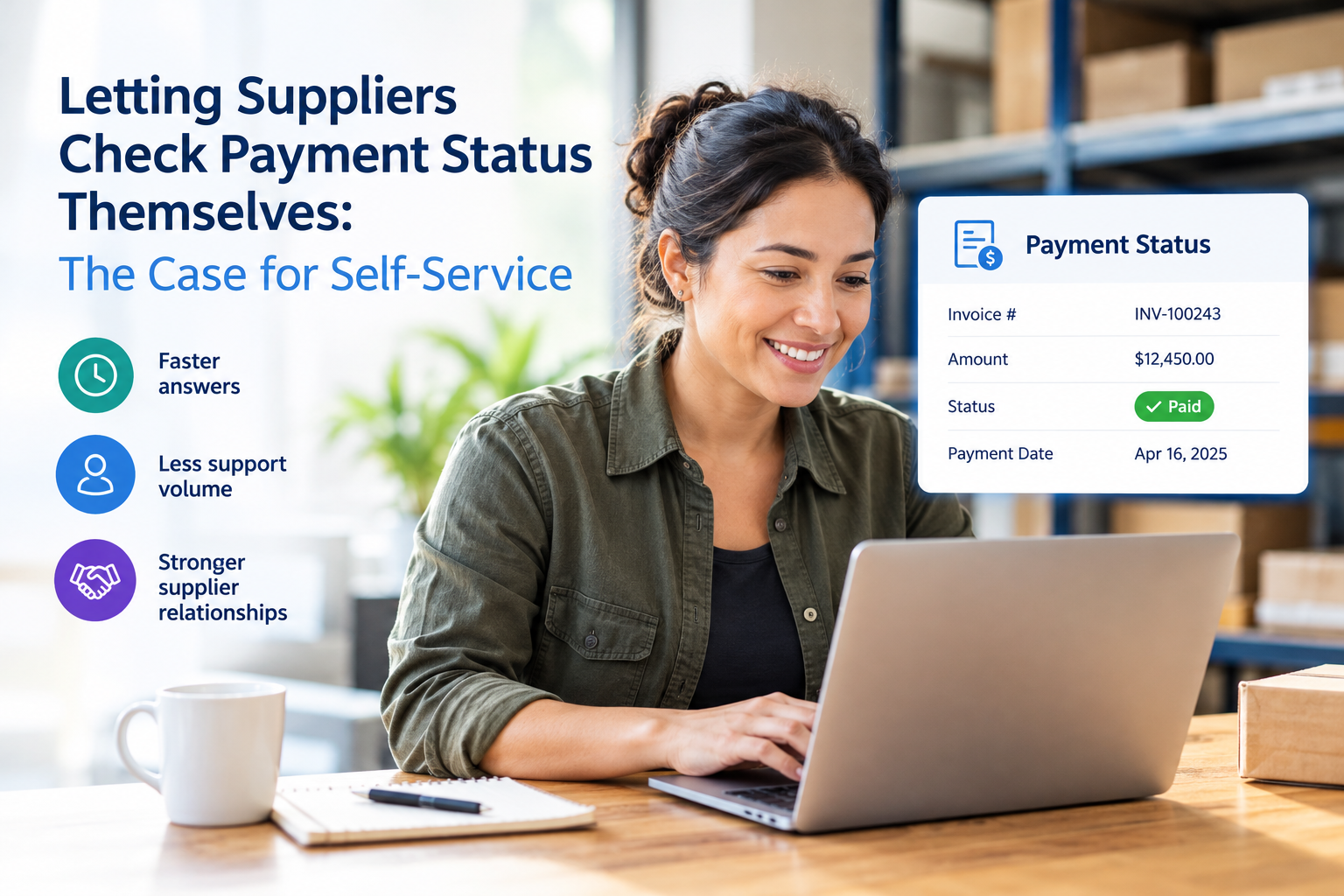
"Where is my payment?" may be the most common question in accounts payable. Suppliers ask it by email, by phone, and through their account managers. Each question is reasonable, because suppliers have their own cash flow to manage. But when the same handful of questions arrive all day, they can take up a surprising share of an AP team's time.
Supplier self-service offers a better way. When suppliers can check invoice and payment status on their own, they get answers faster, and your team gets time back for work that benefits from their attention.
The Questions Suppliers Keep Asking
Most supplier inquiries fall into a few familiar categories:
Invoice receipt. Did you receive my invoice?
Invoice status. Has it been approved, and if not, what is holding it up?
Payment timing. When will I be paid, and by what method?
Remittance details. Which invoices did this payment cover?
Missing information. Is there anything you need from me?
The answers to all of these already exist in your systems. The work is in looking them up, translating them into a clear reply, and sending it, over and over. That is exactly the kind of routine effort that self-service can reduce.
What Self-Service Looks Like
With supplier self-service, suppliers have a secure way to see the status of their own invoices and payments at any time. They can confirm an invoice was received, follow it through approval, see the scheduled payment date, and view remittance information once payment is made. They see only their own information, and they get the answer when they need it, without waiting for a reply.
Benefits for Your AP Team
Fewer interruptions. When routine questions are answered by self-service, the team handles fewer emails and calls, and has longer stretches of focused time.
Faster resolution of real issues. With routine inquiries out of the way, the team can give more attention to the invoices that actually need research, such as exceptions and discrepancies.
More consistent answers. Suppliers see the same information your team sees, so answers do not vary based on who replies or when.
Better use of experienced people. Your most knowledgeable team members can spend their time on analysis and problem solving instead of status updates.
Benefits for Your Suppliers
Answers at any hour. Suppliers can check status whenever it suits them, including outside your team's working hours and across time zones.
Confidence and clarity. Seeing exactly where an invoice stands removes uncertainty. If something is needed, the supplier knows right away and can respond quickly.
Better planning. Visibility into payment dates helps suppliers forecast their cash, which supports a healthy relationship.
Less effort on their side. Suppliers do not have to track down the right contact or wait for a reply to get a simple answer.
Benefits for the Organization
Stronger supplier relationships are valuable in their own right. Suppliers who find it easy to work with you tend to be more responsive and more flexible when you need them. Self-service also encourages cleaner invoice submission, since suppliers can see what is missing and fix it right away, and it helps surface problems earlier. And because status information comes from your process, it reinforces the value of keeping that data accurate and current.
What Makes Self-Service Work Well
Accurate, current data. Self-service is only as good as the information behind it. Status should reflect what is actually happening in your process.
Clear status definitions. Terms such as received, in review, approved, and scheduled should mean the same thing to everyone, with a plain explanation of what comes next.
Easy access. Suppliers should be able to get started quickly, with simple onboarding and clear instructions.
Security and appropriate access. Each supplier should see only its own information, with sensible controls around who can log in.
A path to a person. Self-service handles the routine. For complex or unusual situations, suppliers should always know how to reach a member of your team.
Getting Started
You do not need to roll out self-service to every supplier at once. Many teams begin by reviewing which inquiries they receive most often, and focusing on the questions that self-service can answer. From there, they invite a group of high volume suppliers, gather feedback, and expand. Along the way, it helps to share a short guide that explains what suppliers can see and how to get help.
The Takeaway
Supplier self-service turns a steady stream of status questions into a quick, reliable answer that suppliers can find on their own. Your team gains time, your suppliers gain clarity, and your relationships gain a foundation of transparency. It is a practical step that pays off for everyone involved.
At oAppsNET, our AP Automation helps teams keep invoice and payment information organized and accessible, so answers are easy to find and share. If you would like to talk through how supplier self-service could work for your AP team, we would love to chat. Want to meet in person? Find us at IOFM Fall (Booth 101) and AFP (Booth 1713).