Employee Records Retention That Outlasts Your ERP.
Employees leave. ERPs get upgraded. Compliance obligations remain. OAN keeps every employee document accessible, policy-governed, and audit-ready for as long as regulations require, regardless of what happens to your transactional systems.
Employee Documents Disappear.
Compliance Obligations Do Not.
A manufacturing worker who spent 90 days on the floor three years ago still requires 7 years of document retention. A nurse who transferred between facilities needs credentialing records accessible for the duration of their license. When your ERP gets upgraded and the cutover window only covers recent data, those documents are at risk.
Geography-Specific Retention Mandates
GDPR in Europe, CCPA in California, provincial laws in Canada, country-specific labor codes across Asia Pacific. Each jurisdiction mandates different retention periods for the same employee document.
High-Turnover Industries Lose Track
Manufacturing, construction, logistics, and retail see constant workforce churn. Short-tenure employees still require full-term retention of onboarding, tax, safety, and benefits documents long after departure.
ERP Upgrades Leave Documents Behind
When upgrading from Oracle EBS to Fusion, the cutover window typically covers only 2-3 years of transactional data. Employee documents from prior periods are left in legacy systems or simply lost.
Audits Expose What You Cannot Find
A labor audit, wrongful termination claim, or workers comp dispute can require documents from employees who left years ago. If HR cannot locate them, your organization carries the liability.
Documents Live in OAN.
Your ERP Can Come and Go.
OAN stores employee documents independently of your ERP transactional data. Documents are accessible within the Oracle screens your HR team already uses, but they survive ERP upgrades, migrations, and version changes.
Every Employee Document, One Place, Full Lifecycle
From the day an employee is hired to years after they leave, OAN maintains a complete document vault per employee. Each document carries its own retention rule based on type, jurisdiction, and industry regulation. Retention clocks start automatically on termination date.
Employee
Maria Garcia (EMP-10482) · Terminated 2023-08-15
Offer Letter.pdf
Onboarding · Retain until 2030
I-9 Verification.pdf
Immigration · Retain until 2026
Safety Training Cert.pdf
OSHA · Retain until 2028
Chemical Exposure Log.pdf
OSHA 1910 · Retain until 2053
W-4 Form.pdf
Tax · Retain until 2027
Jurisdiction-Aware Retention Policies
A single employee in Texas has different retention requirements than an employee in Germany. OAN lets you configure policies by document type, country, state, industry regulation, and employment status. The system enforces the correct policy based on the employee’s work location, not a one-size-fits-all rule.
Active Retention Policies
I-9 Employment Verification
United States · 3 years post-term or 1 year post-hire
OSHA Exposure Records
United States · 30 years
Employee Tax Records
United States · 4 years
Employee Contract
Germany · 3 years post-term
Personnel File
France · 5 years post-term
GDPR Subject Data
EU · Right to Delete
Audit-Ready at All Times
When a labor audit arrives or a former employee files a claim, your HR team needs to produce documents in hours, not weeks. OAN’s compliance dashboard shows retention status across all employees (active and terminated), broken down by document category. Gaps are flagged before auditors find them.
4,218
Active Employees
12,847
Terminated (retained)
47
Policies Active
Onboarding Documents
Offer letters, handbooks, NDAs
OSHA / Safety Records
Training certs, exposure logs
Tax Documents
W-4, W-2, 1099 forms
Immigration
I-9, visa, work permits
Built for Industries Where People Move Fast.
High employee turnover creates a compounding retention problem. Every short-tenure worker still generates years of compliance obligations. These industries need automated retention, not spreadsheets.
Manufacturing
Workforce spread across plants. Seasonal and contract labor creates high volume of short-tenure records that must be retained for years.
Key Regulations
OSHA records (5 years), exposure records (30 years), I-9 forms (3 years post-termination)Healthcare
Credentialing documents, continuing education records, and background checks for clinical staff require strict, long-term retention.
Key Regulations
HIPAA (6 years), state medical board requirements, Joint Commission standardsConstruction and Logistics
Project-based hiring with workers moving between sites and employers. Safety certifications and training records must follow the worker.
Key Regulations
OSHA training records (duration of employment + 3 years), DOT drug testing records (5 years)Multi-National Organizations
Employees across jurisdictions each governed by different labor laws. A single policy cannot cover all geographies.
Key Regulations
GDPR right-to-delete, country-specific labor codes (varies 3-30 years), data residency requirementsIntegrated with Oracle Fusion
Everything You Need for
HR Records Compliance
Oracle ERP Integration
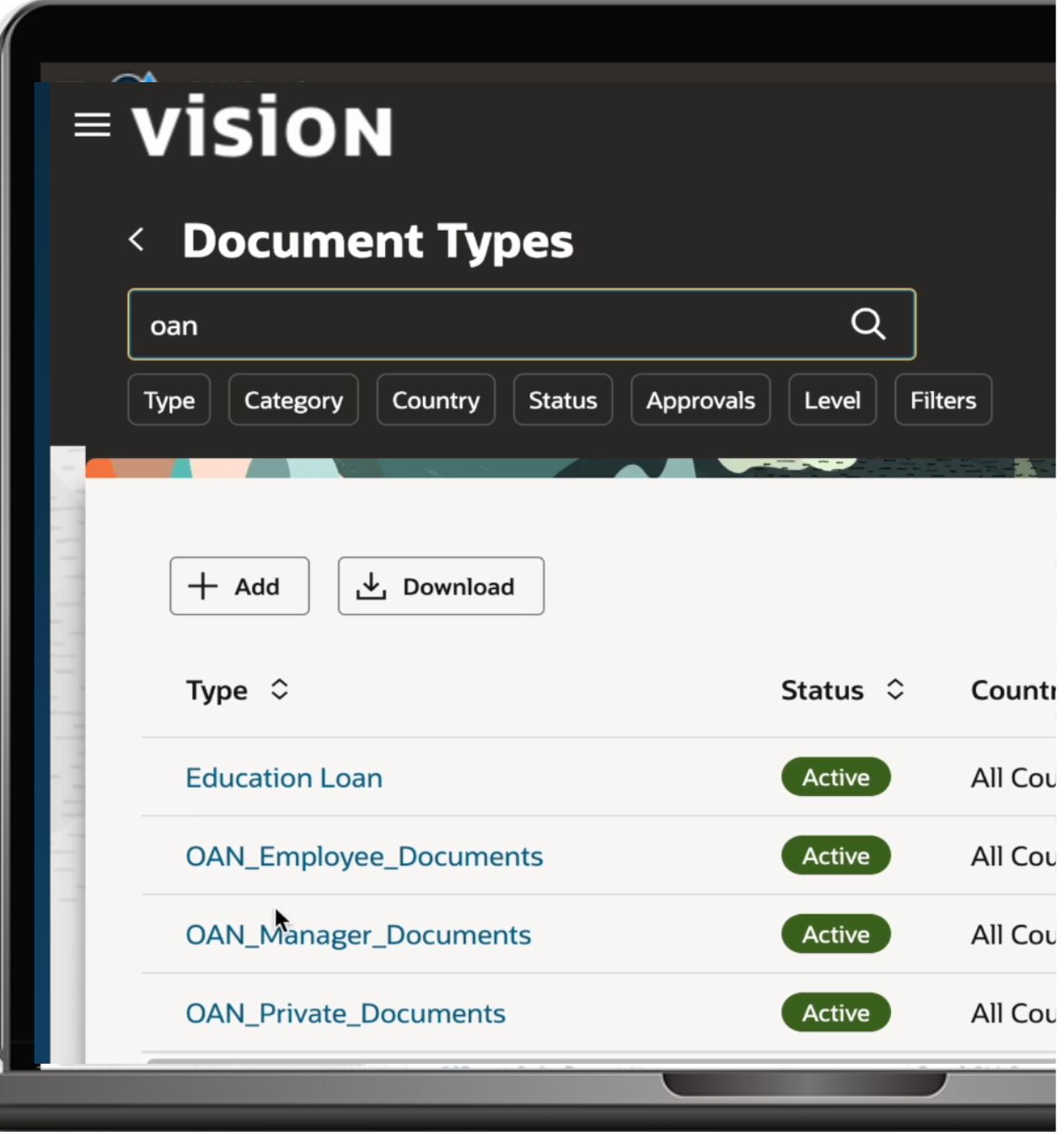
Works as a managed attachment inside Oracle Fusion and EBS. Employee documents are accessible directly within the HR transaction.
Intuitive Interface
HR teams manage documents within the ERP screen they already work in. No separate system, no context switching.
Retention Policy Engine
Build rules by document type, geography, industry, and employment status. Policies enforce automatically with expiry tracking.
Secure and Auditable
Multi-layer encryption, role-based access, and a complete audit trail for every document action. SOX, HIPAA, and GDPR ready.
Workflows and Approvals
Pre-built workflows for document review, approval routing, and deletion authorization. Customizable to your organization.
REST API Architecture
Headless design lets you surface documents in other platforms — portals, intranets, and third-party HR tools — through REST APIs.
AI Classification
Automatic document categorization and metadata extraction. New uploads are classified and filed without manual tagging.
Cost-Effective Storage
Cloud-native with OCI Object Storage. Scale on demand without upfront infrastructure. Pay for what you store.
Stop Carrying the Risk of Missing Employee Records.
Schedule a demo and see how OAN HR Records Retention keeps every employee document compliant, accessible, and audit-ready — regardless of how your ERP landscape changes.
Frequently Asked Questions
All types: offer letters, I-9 forms, W-4s, performance reviews, safety training certificates, benefits enrollment, disciplinary records, termination paperwork, and any other document tied to an employee record. Each type gets its own retention rule.
When an employee is terminated or resigns, OAN automatically transitions their documents to post-employment retention policies. For example, I-9 forms are retained for 3 years after termination or 1 year after hire date, whichever is later. The system tracks these timelines automatically.
OAN stores documents independently of your ERP transactional data. When you upgrade from EBS to Fusion or migrate between versions, employee documents remain intact and accessible. No documents are lost in the cutover window.
Yes. Configure retention policies by country, state, or region. A US employee's I-9 follows USCIS rules. A German employee's contract follows GDPR and BetrVG requirements. Rules are enforced per employee based on their work location.
Yes. GDPR deletion workflows include approval routing, impact assessment, and a complete audit trail of the deletion action. The system distinguishes between documents that must be deleted and those with a legal retention obligation that overrides the deletion request.
OAN provides bulk import capabilities for documents migrated from legacy ERP systems, shared drives, or file servers. Documents are indexed, classified, and assigned to the correct employee record with appropriate retention policies.
Any organization with employee document retention obligations, but particularly manufacturing, healthcare, construction, logistics, retail, and multi-national organizations where high workforce turnover and geographic complexity make manual tracking unsustainable.